

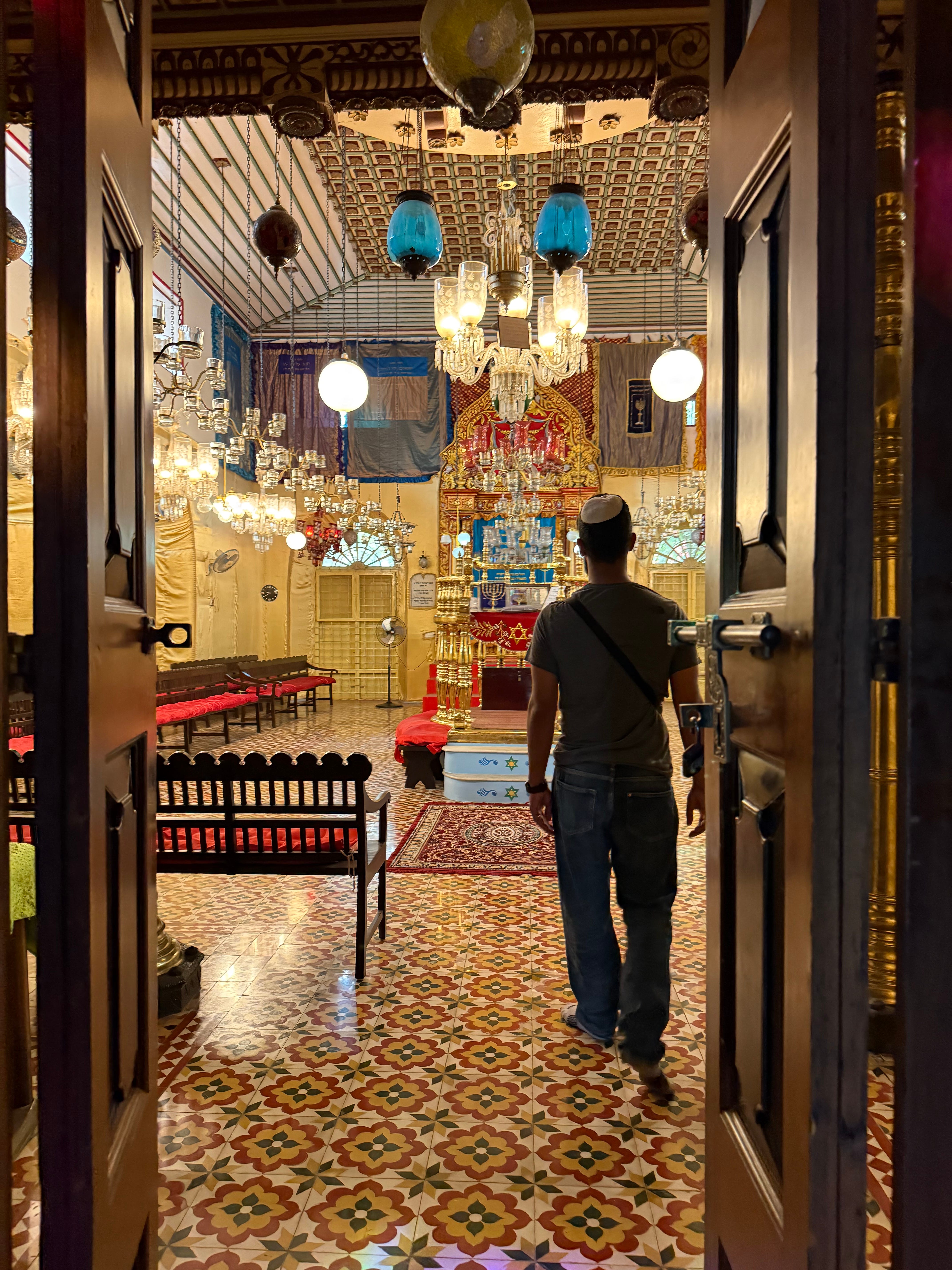
The past two weeks my husband and I have been traveling through South India, in Kerala. It’s somewhat of a heritage trip for him; his paternal grandparents were born in Kochi and moved to Israel with their Jewish community in 1954, and despite this being his first time in India, Ofek has grown up eating Cochini Jewish foods, hearing Malayalam, and praying Cochini Jewish piyyutim. Just in general, he’s had a deep exposure to the culture in his moshav of Ta’oz, one of the few villages the Cochini Jews settled when they first arrived to Israel.
For so long, I’ve tried to describe to him the condition that so many new immigrants in Israel live with, which is both a deep sense of belonging intertwined with feeling like an outsider. He, of course, never truly understood what I meant— he was born in Israel, and his family has been there for three generations— that is, until we arrived in Kochi.
His emotional reaction was unexpected. Suddenly and all at once, he understood the experience of dual homelands, a rather complicated experience for Jews born and raised in the Diaspora.
To be specific, he described feeling a sense of belonging in Kerala. There, he was immersed in the language of his grandfather; the small expressions and idiosyncrasies of people in his moshav; the food he grew up eating; the snacks, the culture, even the physical attributes of people around him. He felt delighted any time someone assumed he spoke Malayalam, or thought he was an Indian national when buying tickets to local nature preserves— which are 50% less than what foreigners are charged. Essentially, his experience visiting Kerala was much like many diaspora Jews’ experiences visiting Israel. It felt like a second home, and indeed when I asked him if he felt a sense of homeland here, his answer was a definitive yes.
My own understanding of homeland, too, is layered and complicated, as it is for most Jews. My mother’s family has been in the United States for four generations, and she grew up completely integrated into American Jewish culture, which without a doubt informs my own sense of complicated belonging in the U.S.
My dad, on the other hand, was born in Iran, although his first language was Arabic, because his parents were born in Iraq. He must also have an intricate experience of belonging to all those places, not excluding the United States and Israel, given that he’s lived in the U.S. since he was eighteen and always felt deep connection with Israel, living there for a few years as a child as well. I’ve lived in Israel for the last three years, and my family has visited the country more times than I can count. It is without a doubt a kind of second home to them, too.
Dad has frequently talked about wanting to visit Iran one day. Whenever he says it, I can see in his eyes a beautiful glimmer of memories, a throaty nostalgia in his voice. He’s mentioned wanting to visit Iraq one day, too, but I believe that comes more from a curiosity of seeing the place where his parents came from— although I know speaking the dialect of his parents effortlessly with ordinary people around him would be extremely moving for him.
I ponder all of this as my husband and I travel through India, visit old Jewish sites, and meet locals, all while millions in Iran protest for their freedom. Nearly every day, we check the news to see what’s happening: how many protesters have been killed today, flights to Israel being canceled, heating rumors of imminent war with the U.S., Iran’s currency value plummeting by the day. I’ve written so much of my Iraqi heritage, but the truth is, my Iranian one has been just as influential on my life. I heard Arabic around me growing up, but heard just as much Persian, which my father spoke with his siblings; I grew up eating tabeet and bamya and kubbeh, but my favorite foods are gormeh sabzi, fezenjoon, and koresh bademjoon. After a bad breakup in 2021, I listened to Hayedeh’s “Minaye Del” (Heart of Glass) on repeat for a week; Googoosh was my top artist in my 2025 Spotify Wrapped, and I was in her top 1% of listeners. My favorite movies are Persian— Children of Heaven, Taste of Cherry, and The Separation— and one of my best friends in high school was Persian too, which is probably not a coincidence…
Perhaps if I visited Iran one day with my dad, I might feel the same thing my husband now feels in Kerala. The world today lacks so much nuance and room for complexity. These days, it seems everyone must “belong” to one place and one place only. Both the left and the right have been poisoned by a zero-sum game of identity essentialism.
Therefore: I was born in the U.S., live now in Israel, and am traveling through the land of my husband’s ancestors in South India, and all the while, can’t stop thinking about Iran. Because somehow, I too feel connected to the deep pain there, having the stories of my father’s family escaping Iran ingrained in my heart. But also from my love and admiration of Persian culture, whose language, poetry, and taarof1 has imprinted itself on my soul like a fossil (my favorite phrase in Persian, which is meant to be said to someone who just apologized for facing their back to you— considered rude in the culture— is gol posht o rou nadare, which means “a flower has no front or back”).
That is why I write about homeland now, despite being in the middle of my vacation in a remote part of Kerala with dodgy internet access and no laptop— I wrote this all first in my journal and then typed it up on my notes app— because my heart is filled with love and pain for the people of Iran, for Iran itself, which perhaps is also some kind of homeland for me in my life of many homes. Some of which I’ve been to and some of which I’ve not.
The truth is, I don’t know if I will ever visit Iran one day, despite everyone’s increasing hope that the current people’s revolution— against the literal Revolution— that we’re seeing now will succeed. That whatever leader that one day replaces the current tyranny will be better and more just, ensuring freedom to Iranian people. I remain deeply uncertain. Contrary to popular belief, when the Berlin Wall fell in 1989, it was not because of mass protests or civil disobedience. It fell because usually, anyone who tried to climb over the wall and cross over was shot on spot— and one day, people started climbing the wall as they usually did, but the Soviet guards just didn’t have it in them to shoot them anymore. Once that happened, it all fell apart. Brutal regimes like Iran’s will never fall unless there’s a crack within the authority that lessens its brutality when protest happens.
But I digress. My father’s childhood home is burning from within, and all I can do is watch and pray that some renewal emerges from the ashes. I have written essays about Iraq, waxed poetic about my grandmother’s village in Nasiriyah, the Tigris River, Baghdad, let my heart bleed when writing about Israel, let tears well in my eyes when I’ve watched Persian movies. I have dreamed about visiting Tehran and I’ve invented prose about America. I carry each of these places inside of me. Their histories, cultures, and landscapes flitter around in my stomach like butterflies, exciting and nauseating me until I vomit out stories and words about them. But here is the non-romantic truth: I feel that I belong to so many cultures, and so many places, that often I feel I belong nowhere at all.
This is a rather privileged emotion, given that my ancestors’ experiences of unbelonging stemmed from literal oppression and expulsion from their societies. But I share this feeling honestly, and I know many others share it as well. Maybe I am experiencing the future for the modern, globalized person. A future in which most people will belong everywhere and nowhere at the same time, despite toxic nationalism— which engulfs every part of our world today— that says otherwise.
For me, at least, it is the most persistent confusion of my life. My upbringing was very culturally conservative and Jewish, mixed with Middle Eastern parenting. Because of this I’ve sometimes felt a specific cultural struggle with fitting into the “American” crowd. Yet because I was raised in the U.S., its influence on me runs deep. So deep that, ever since living in Israel, I too often find it hard to fit in with Israelis around me. Wherever I go, I wonder if I belong; where my homeland is, and what a home or a land even means in 2026. I feel connected to so many places in the world; my heart swells and breaks for them each in different ways. “Perhaps home is not a place, but simply an irrevocable condition,” James Baldwin wrote in his 1961 essay, Nobody Knows My Name, which he published after living in France for some time. Despite living in Europe, Baldwin reflected, having physical distance from America still did not free him from the history, identity, and obligations that had already formed him.
Perhaps for me, too, no amount of movement or distance can undo the multiple histories and cultures that have already shaped me. I am incurable of the places that formed me. Even by the ones I have never been in.
The nuanced art of Persian social etiquette, expressed through ritual politeness, deference, and courteousness involving compliments and subtle gestures where one offers indulgences they might not truly mean— or refuses things they actually want— in order to show respect to elevate and honor the other person. For example: refusing food or drink multiple times when offered before finally accepting, insisting someone eats the last bite of food even if they’d like to take it, and playfully fighting over paying for a restaurant bill.
Throaty nostalgia in your dad’s voice when you mentioned Iran to him 🥺❤️
If you would like to learn more about Iran’s cultural and literary heritage, please check out my articles and don’t hesitate to restack them if you find them inspiring 🙏🏼
https://mahnazhatami.substack.com/p/iran-and-the-sugar-of-farsi?r=6a6pnp&utm_medium=ios