
Omar Riad is a Moroccan Creative Director, Brand Strategist, Digital Marketing Coach, and youth educator based in Casablanca. His work sits at the intersection of branding, communication, culture, identity, and the development of Morocco’s next generation.
There is something strange about the way my generation encounters Moroccan Jews. We know they existed; we hear them in music. We walk through old mellahs. We see restored synagogues. Our parents and grandparents sometimes speak about Jewish neighborhoods with a certain familiarity, a perspective that is almost impossible for a younger Moroccan to embody: Jews as local merchants, or a family next door, a singer everyone knew, or the owner of a shop that once stood on a certain street.
They appear constantly in our memories, but rarely in the present. For many young Moroccans today, the loudest context in which we encounter the word Jew is the Israeli-Palestinian conflict. Say the word Jew, and for many young Moroccans, their imagination will travel to Israel, Palestine, Gaza, Zionism, and war; politics have rewritten our history backwards. When living contact disappears, political categories can replace human memory. There are the Jews from our grandparents’ stories, and the Jew in our political imagination, somewhere far away. Over time, almost without noticing it, we have inherited a Morocco deeply shaped by Jewish Moroccans while it becomes harder and harder to imagine a Jew as “naturally” Moroccan.
That contradiction began to disturb me; the more I thought about the depth of Moroccan Jewish history, the less I understood why I ever imagined it as the history of an “outsider” community. It’s not “another” history, tangentially related to Morocco’s: it is ours. It is known that Moroccan Jews were a minority, but sometimes, I found myself resisting that word—how could a community that left such a visible cultural footprint be called a minority? Yet being a minority is not a measurement of cultural importance. Certainly, not in Morocco.
By 1948, Morocco was home to roughly 270,000 Jews, but today, only a small Jewish population remains. The demographic transformation was enormous; but their footprint has yet to disappear. Moroccans are obsessed with where other Moroccans come from: Fassi, Tetouani, Doukkali, Riffi, Soussi, Marrakchi, Amazighi. These geographic labels carry pride, affection, and sometimes teasing—and sometimes, if we are being truthful, prejudice. We stereotype one another by city, region, accent, tribe and origin. This reveals something profound about how Moroccan identity works; we do not simply call and relate to each other as Moroccan, but locate one another inside Morocco. Jewish Moroccans inhabited that very same map. There are Jews from Fez and Tetouan, from Essaouria, the Atlas and the south; communities speaking different dialects of Arabic, Amazigh languages, and in the north, Haketia. Moroccan Jewish life itself was not a monolith, but too differed greatly by city, region, and social world. A Jewish Moroccan could be Tetouani just as a Muslim Moroccan could; a Jew could carry Fez in his accent, a dish, a melody, or a particular local pride just as a Muslim Fassi could. Instead of imagining Moroccan history simply as Muslims on one side and Jews on the other, perhaps Moroccans today should more accurately imagine our identities constantly intersecting one another. After all, we came from the same cities, mountains, and markets, and had the very same accents, rivalries, and attachments to our origins.
When did we stop asking Moroccan Jews where in Morocco they came from, and begin to imagine their Jewishness itself as a place of outside origin?
Moroccan Jewish musicians, for instance, were not standing on the periphery of Moroccan culture, occasionally contributing something exotic to it; they were inside the very mechanics of its production. The great artist Samy Elmaghribi, for example, belongs not only to Jewish musical history but to the making of modern Moroccan popular music, and even to the development of Moroccan nationalism itself. Moroccans readily acknowledge that “Jews contributed to our culture,” meaning “they” to “ours.” It assumes that Jewish history is a special subject somewhere inside the larger Moroccan story. As though Moroccan culture existed independently first, already complete, and Jewish people occasionally added something of importance to it. But Moroccan Jews were among the very people who made Morocco. Removing them from our national identity leaves our understanding of Morocco itself incomplete.
Moroccan culture emerged through centuries of encounter: Arab and Amazigh, Muslim and Jewish, African and Andalusian, Saharan and Mediterranean. Trade migration, proximity, borrowing, conflict, and exchange contributed all to what we now simply call “Moroccan.” When something has been created through centuries of cultural exchange, it cannot be separated simply into religious ownership. But this creates a strange paradox: Jewish cultural contributions can become harder to recognize precisely because so much of what Jews created simply became “Moroccan”; we’ve inherited the enormous contribution while forgetting those who played a role in making it.
There is another scene from older Moroccan life that I think about often: milk, and the various stories I’ve heard from places such as Sefrou of Muslim and Jewish women nursing each other’s children. To be clear, this is not an attempt to turn such stories into a national mythology; I cannot claim every neighborhood lived this way. But the image itself is extraordinary, especially for a Muslim. Breastfeeding establishes kinship in Islamic law, which has familial consequences that extend far beyond the simple act of feeding a child. So consider how radical the intimacy is in a memory of Muslim and Jewish women nourishing each other’s children. Whatever religious boundaries existed between families, another relationship was created above it, a child who lived through another woman’s body. How did we, in only one or two generations, move from that kind of close, intimate proximity to one where the word “Jew” can sound entirely external to Morocco?
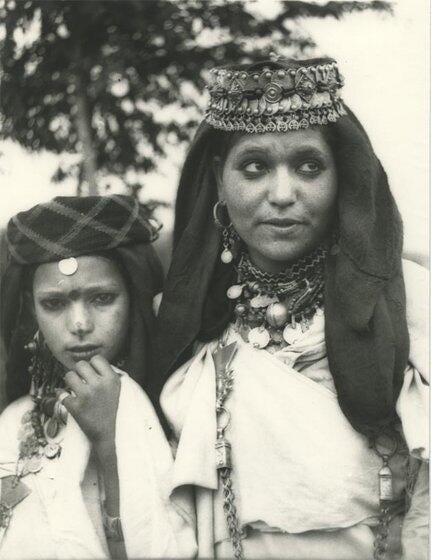
Our grandparents could disagree with a Jew, trade with one, distrust one, love one, argue with one, sing with one, shop with one, even nurse one’s child—but now their absence in our society makes abstraction easier. None of this should imply that life in Morocco used to be a fairy tale, and I myself know that Morocco was not a simple paradise of Muslim-Jewish coexistence. There were periods of intimacy and exchange, but also inequalities, discrimination, legal hierarchies, tension, and violence. But the Muslim and Jewish communities in Morocco did not need to have loved one another constantly in order to have made a country together, which is why I find the term co-creation more accurate than coexistence. Coexistence can make two communities seem like separate entities that happened to occupy the same territory, but co-creation sees what they made through living besides, against, and with one another. Jews and Muslims in Morocco had great differences between one another, yet they participated in making Morocco together.
Of course, there was never just one Jewish departure story, either. This is another simplification that makes me uncomfortable: the idea that all Moroccan Jews simply fled Morocco. Some certainly left because they were afraid or insecure; antisemitism mattered; the creation of the State of Israel, Zionism, and regional politics all mattered in this too. Poverty and political uncertainty also played major roles, and Moroccan Jews migrated not only to Israel but to France, Canada, the United States, and elsewhere.
Around them, Morocco itself was entering a much larger history of migration; while large-scale Jewish emigration from Morocco began earlier than Muslims’, from the 1960s onward, large numbers of Muslim Moroccan workers also left for France, Belgium, the Netherlands and Germany. Both of these histories demonstrate something Moroccans know very well: a person can love their country and leave it. A person can experience hardship or discrimination there and still know it as home. A person can build a life elsewhere without becoming foreign to the place they or their ancestors left. Someone born in Belgium can still say, my family is from Nador, and someone born in the Netherlands can still call themselves Riffi. A family can spend generations in France and continue carrying Fez, Casablanca, or Oujda inside their identity.
We understand this instinctively. So why should migration erase the Moroccan-ness of a Jew? Why should a Muslim Moroccan born in Brussels inherit Morocco naturally, while a Jewish person born in Israel saying, “My family is from Tetouan,” sounds surprising? Departure should not have the power to rewrite one’s belonging. I work with young people, and because of that I think constantly about what kind of country the next generation will inherit. I want Morocco to become a place where people can flourish: where they can work, build, create, grow, stay if they want to stay, leave if they want to leave, and return if they choose to return. Development is not only infrastructure, employment, education, technology, or investment. A strong country also needs a strong understanding of itself. Morocco itself officially recognizes Hebrew heritage as one of the historic components of its national identity, but institutions can restore synagogues and preserve cemeteries much more easily than actual societies can restore living memory. The harder dilemma is how there can be an instinctive understanding that a Jew can be just as Moroccan as any other, when most Moroccan youth have never knowingly met one.
Contemporary politics can easily become the lens through which we interpret Jewish identity today, but Moroccan Jewish history—Jewish history—is much older and much larger than that political framework. A Jew is not a synonym for Israeli; Israeli is not a synonym for a Jew; Moroccan Jewish history did not begin in 1948; and yet. I often wonder about younger Jews of Moroccan descent abroad, especially in Israel. What does Morocco mean to them? A homeland? A grandparent’s country? A cuisine? A synagogue melody? A family story? Do they still call themselves Tetouani, Fassi, Marrakchi, Amazighi? A young Muslim living in Casablanca may know very little about Moroccan Jewish culture, while a young Jew thousands of miles away may be learning Moroccan songs from his grandmother and passing down the name or neighborhood of a Moroccan city through family stories. Where, then, does Morocco exist? Inside its borders, and in those who have carried it away?
I do not expect Moroccan Jews abroad to “come back.” People have built their lives and identities elsewhere, and history cannot reverse. I do not want Moroccan Jewish history recovered because I am nostalgic for the Morocco of the past. What I hope for is different. I want Morocco to remain available to them, as a history, inheritance, relationship, and—if they choose—a place in which they can be part of once again. A confident country should not force its diaspora to choose between the life they built elsewhere and the place their families come from. Morocco does not need to invite Jews back into its national story; they were never outside of it, and so perhaps what we need is to learn how to see them there again. Morocco cannot fully understand its present, or its future, if it misunderstands who helped make it.
Really good content. I genuinely enjoyed reading this article. It was especially interesting to think about how deeply Moroccan Jews were woven into Moroccan history and culture, and how easily that part of the story can become forgotten.
It also made me think about a similar story in Ethiopia. Northern Ethiopia has a long and fascinating history where Jewish, biblical, and Christian traditions became deeply intertwined. The indigenous Beta Israel community lived there for centuries alongside the Christian kingdoms, while Ethiopian Orthodox culture itself preserved many traditions and ideas that have strong connections to the Hebrew Bible.
It reminded me that when we talk about African history, we sometimes separate Jewish history from African history; as if Jewish communities were simply outsiders living in Africa. But Morocco and Ethiopia tell a much more complicated story. These were African communities whose identities, cultures, religions, and histories became intertwined with the societies around them.
Just as Moroccan history is incomplete without acknowledging Moroccan Jews, I think Ethiopian history is incomplete without acknowledging Beta Israel and the broader Jewish and biblical influences that shaped northern Ethiopian history.
Really enjoyed this perspective. It made me think about how many parts of African history we may have forgotten or oversimplified.
I really enjoyed this one. My Ashkenazi mother lives in Marrakech and I have been to visit. A lot of the older folks we spoke with lamented over the felt absence of the Jews. Thanks for this piece, Omar.