

“I don’t usually engage in discussion with Zionists, anti-Semites and racists as they simply end up believing their views are legitimate. However, I’m going to make a small exception in your case…”
This was the beginning of the Twitter-viral email exchange that Noam Dworman, owner of New York’s Comedy Cellar, had with Andreas Plecko—a Frankfurt-based editor at Dow Jones—after Plecko contacted Dworman unsolicited to defend Benjamin Moser’s recently published book, Anti-Zionism: A Jewish History. (Dworman recently interviewed Moser on his podcast and was sharply critical of the book and its historical arguments). Unfortunately, the fact that an editor of a major news organization has a policy against engaging with Zionists was the least appalling aspect of the exchange.
Plecko’s worldview is a particular complex one that plagues many pro-Palestinian Germans like him: their intense love for Palestinians is based on their hatred of themselves for what they did to Jews. There are far too many bizarre claims Plecko makes to address individually—including comparing Israel’s justification for launching the 67’ war to Adolf Hitler’s invasion of the Soviet Union, descriptions of Palestinians as “the most oppressed people in the world (as Jews once were)”, and accusing Zionists of deceiving the West about their supposed settler-colonial project—but among the many claims in Plecko’s correspondence, one passage in particular deserves closer examination:
“However, at the time of Israel’s founding in 1948, there was a major problem: After the Holocaust, there were not many Jews left in Europe. And most of the survivors of the genocide emigrated to America, Canada, or Australia. Therefore, the country had to be filled with Arab Jews. But the Jews from Arab countries were not Zionists.
Ben-Gurion wanted the Arab Jews as citizens and soldiers but strictly rejected their cultural identity. He viewed them as ‘material’ that had to be reshaped according to the model of European Zionism. They were therefore subjected to a strict program of ‘de-Arabization’.
In 1950, a term was specifically invented for these people because the word ‘Arab Jew’ was frowned upon – and still is today: They were called ‘Mizrahim’ – ‘Easterners’, even though many came from the South and West. And they always remained second-class citizens.
In Israel today, as in apartheid South Africa, there are a total of four groups of people distinguished by privileges: Ashkenazim (whites), Mizrahim (mixed race), Palestinians with citizenship (Indians), and Palestinians without citizenship (Blacks).
To be a Jew in Israel today primarily means not to be an Arab. And yet, demographically speaking, Israel is an Arab country. Over half of the Jews in Israel come from Arab countries; together with the Palestinians, almost 80 percent of the inhabitants are Arabs.”
Plecko’s account of the arrival and absorption of Jews from Arab countries into Israel rests on several distinct claims. First, he suggests that Israel’s founding created a demographic problem: following the Holocaust, there were supposedly too few Jews left in Europe to populate the new state, and the country therefore had to be “filled with Arab Jews.”
How so many Jews from the Middle East and North Africa ultimately arrived in Israel is conveniently omitted, but it does make me wonder whether Plecko is aware that over 800,000 Jews were expelled from their communities across the Arab world, many fleeing persecution, violence, and state-sponsored discrimination while others faced denaturalization and the confiscation of their property.
I would expect Plecko to know, as a German, that in the decades preceding and following Israel’s establishment, antisemitism across the Arab world exploded upon the convergence of local anti-Jewish hostility, Arab nationalism, and Nazism. Indeed, Nazi Germany made a concerted effort to disseminate its propaganda throughout the Arab world, broadcasting its vile, anti-Jewish messaging in Arabic and cultivating relationships with pro-Nazi Arab political figures, including Hajj Amin al-Husayni, the Mufti of Jerusalem and father of Palestinian nationalism. It is absurd to say that the “Arab Jews’” eventual arrival to the State of Israel was simply a demographic solution undertaken by Zionist leadership.
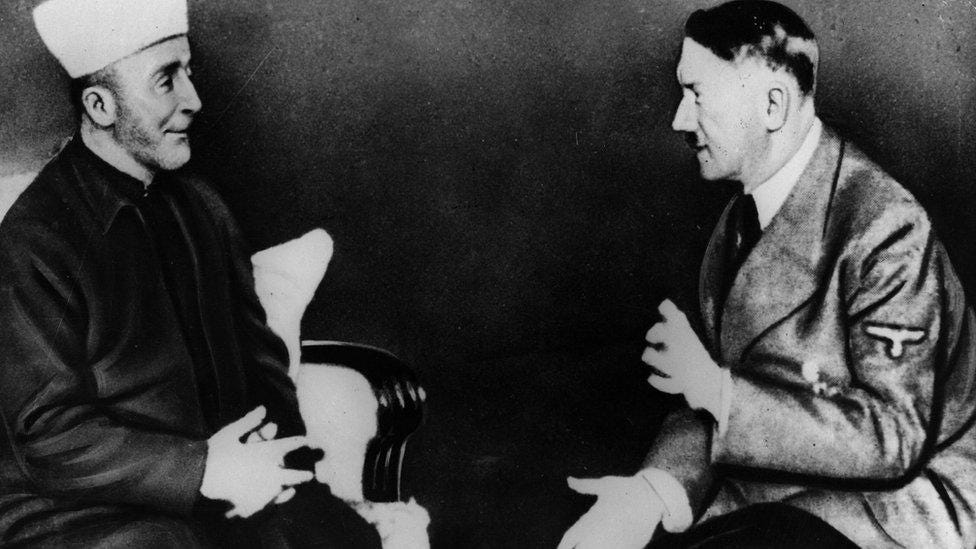
Indeed, the violence began long before Israel’s establishment: in June 1941, the Farhud occurred, a pro-Nazi pogrom in which Jewish homes and businesses were looted and Jews were massacred, mutilated, and assaulted by their local Arab neighbors. Further anti-Jewish violence followed in Cairo and Tripoli in 1945, Aden and Aleppo in 1947, and elsewhere. In Iraq, nearly 120,000 Jews fled during the mass exodus of 1950.
(Perhaps Plecko, upon learning this, would still find some justification for their expulsions: after all, Iraqi Jews had an organized Zionist movement dating back to the 1920s, with a second period of intensified activity following the Farhud. Throughout the 1920s and 30s, Zionist organizations were also started in Iran, Egypt, Libya, and Morocco.)
As Rachel wahba succinctly articulated in her essay, “This Arabic Jew”:
“It was only after I discovered Albert Memmi in 1976 that I learned how to frame my identity as an Arabic Jew. Memmi’s essay, ‘What is an Arab Jew’ [unpacks] how we were shaped by the Arabic cultures we lived in and how at the same time as Jews, we did not, could not, go all the way. We acculturated but never assimilated. We could never be Jewish Arabs the way American Jews can be Jewish Americans.
A Jew could not be a Jew and an Arab, we were not allowed to integrate and become Jewish Arabs. Memmi’s work clarified for me how the Jew was and was not Arab – how we were Arab Jews but never Jewish Arabs…Fortunately or unfortunately, it was never possible for a Jew to assimilate and identify as a ‘Jewish Arab’ the way an American Jew can be a Jewish American. We never forgot our first nationality was Jew.”
That said, Mizrahi Jews are not a marginalized population at the periphery of Israeli life and culture, either. While it is true that Jewish immigrants from the Arab world faced discrimination in the early decades of statehood, including discriminatory housing and absorption policies and other forms of institutional marginalization, today, "Mizrahi culture is dominant in Israel society. Its music, food, political influence, and cultural figures are so woven into the country’s mainstream to the point that it’s no longer even considered distinctly “Mizrahi,” but Israeli.
Therefore, their place in Plecko’s racial hierarchy is fascinating. He seems perplexed by the existence of Jews whose families came from the Arab world; and that is why they are the central to the fantasy he constructs about Israeli society. He regards Jewishness and Arabness as two separate racial categories, with Mizrahi Jews occupying some intermediate position between them. Their “intermediateness” is what allows him to use them so flexibly in his argument. When he needs an explanation for why Jews from Arab countries are part of Israeli society, he describes them as a Jewish population brought to Israel to fill the country after the Holocaust. When he needs to establish a “white” minority ruling over an Arab majority, they magically become Arabs and are part of an oppressed “80 percent.” But when defining Jewishness in Israel, he writes that it “primarily means not to be an Arab.”
To him, Mizrahi Jews are Jewish when their presence contributes to Israel’s oppressive Jewish character, but Arab when their ancestry helps establish its supposedly Arab demographic majority. Their identity changes according to what Plecko needs to make his own scrambled understanding internally coherent.
This is especially absurd given the actual place Mizrahi Jews occupy in Israeli politics. Perhaps Plecko doesn’t realize that Mizrahi voters were the ones who brought Menachem Begin and Likud to power in 1977 and today are the most important constituency for the Israeli right. For decades, Shas—the political party for ultra-orthodox Sephardi and Mizrahi Jews founded in 1984—has held the country in a political chokehold in all matters regarding religious affairs, education, draft laws, and public spending. Its founder, Rav Ovadia Yosef z”l, has quite literally called on God to strike the Palestinians and Mahmoud Abbas with a plague, comments that “Satanjahu” (as Plecko refers to him in his emails) publicly distanced himself from.

Yet it is “Satanjahu” himself that Mizrahi Jews have kept in government for decades; our own Ben Gvir is Mizrahi, too.
That’s all to say that ethnic distinctions are far less important in contemporary Israel than ever before. The majority of Israelis have both Mizrahi and Ashkenazi family backgrounds. There is still some subtle racism in the older generations, but these days, the most politically and socially consequential divisions are between being religious and secular. Even so, in an apparent effort to explain the apartheid-like racism he attributes to Israeli society, Plecko resorts to precisely the kind of racial essentialism that his argument claims to condemn.
Mizrahi Jews are perplexing to people like Plecko, who understand the world exclusively through their own country’s bygone sins and racial frameworks, from Nazi Germany, apartheid South Africa, American slavery and Jim Crow. They cling almost obsessively to the conflicts of the present because it gives them an opportunity, in their own minds, to atone for their nation’s historical sins. While Israeli society continues to grapple with its own future, Plecko seems unable to recognize how much of his own worldview remains captive to the past.
Cover photo by Nitzan Dror, Ynet.