
Jonpaul Yohanan “Sione” Cohen is a psychology researcher and rabbinic student from Hataitai, Wellington, now living in Southern California, whose family traces its heritage to Sephardi immigrants who settled in the Pacific generations ago. He has previously published poetry for the Hawaii Pacific Review, and has participated in published research on psychological wellbeing in the South Pacific region.
I had crossed an ocean’s worth of borders before I ever truly saw one. On my Birthright trip we drove up from the Jordan Valley, away from the Yarmouk, toward the disputed Golan Heights. The climb was almost lazy, and then Mount Bental arrived, and almost as quickly, so did the edge of Israel. The land just stopped with a line in the sand.
Most of the students on my Birthright bus had grown up treating borders as ordinary things: weekend trips to Ensenada, infographics on Instagram, immigration debates over dinner. I had only recently moved to Southern California, and I had never once seen the U.S.–Mexico border myself, or any land border for that matter. The idea of a country simply ending still felt more foreign to me than whatever lay beyond those towering fences.
My mind wandered as the guide talked about the Yom Kippur War with Ba’athist Syria, past the bored college students, past the guards, past the UN peacekeepers, to Quneitra. I tried to imagine what it was like to stand in that other country, just a twenty-minute walk away. I could barely picture myself 229 meters above the horizon, looking down from a dormant volcano onto the ruins of cities not unlike the towns we had passed on the drive up. Try as I might, my imagination was limited by the novelty of this great rift, drawn by Cold War strong-men long gone.
A post with signs caught my eye, each pointing toward a different global city, denoting by distance how far away it was. סידני 14,136 ק׳׳מ, “Sydney, 14,136 km.” I don’t think anyone can really fathom a distance that size in their head, let alone the extra 2,232 km from Sydney to anything resembling home.
Home for me is a village called Hataitai, just outside Te Whanganui-a-Tara Wellington, the capital of Aotearoa New Zealand. I couldn’t imagine a more different place from where I stood. Our awa, rivers, are not demarcated with guns. Our maunga, mountains, are not blurred on Google Maps for security reasons, and our taiororua, valleys, are not weaknesses to be defended. I could wander along those familiar beaches forever and always circle back home.
My family are not tangata whenua (Indigenous Māori), but the land adopted us as tangata tiriti, immigrants, and in my case distant cousins to the Indigenous tribes. In the 18th century, the islands of Sāmoa were connected to the non-oceanic world through European contact. When Europeans settled these islands they established colonies with enormous maritime trade empires, making Fiji, Sāmoa, and Tahiti particularly valuable archipelagos. As Europeans trickled in, so did Jewish migrants from around the Jewish world. Sāmoa’s Sephardi community began in Western Sāmoa with small migrations from Portugal before the Germans took over the island. Under the traditional chieftain system, immigration was largely regulated by familial heads who granted citizenship through “naturalization” into a village and known family clan. One prominent family, de Silva, was permitted to stay in Sāmoa through marriage into the Chiefly Fiame family.
When the German government began to rule over the island in the 19th century, Berlin started encouraging migration to Sāmoa, and of course, many Jews began a new life there. By the 20th century, the German Jewish community grew in Apia and even brought a cantor—when New Zealand took control from the Germans after WWI, most of the German Jewish population migrated to New Zealand, although a few families remained.
But the Sephardi community in Sāmoa, already two centuries old, had become deeply integrated into the traditional local clans. As German Jews immigrated to the more developed New Zealand, the Sephardi community stayed, now themselves occupying positions of chieftainship over their own villages. Today, many Jews in independent Western Sāmoa have Sephardic ancestry, while in American Sāmoa, Jewish individuals are primarily of American descent, having followed their own unique migration patterns.
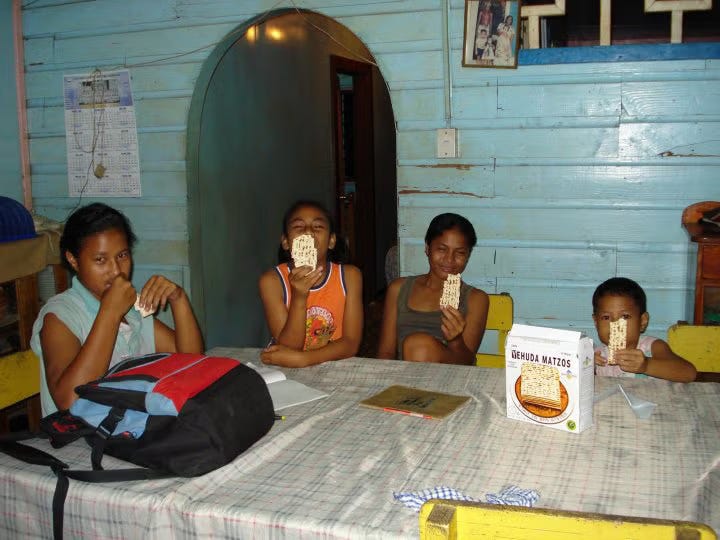
The Jewish community my grandparents inherited in Sāmoa has mostly dispersed now: like the de Silva family, who married into Anglo Sephardi families, many Jews left for Australia, Aotearoa New Zealand, New Caledonia, and the United States following the departure of the island archipelago’s sole khazan, Samuel Kronfeld, to Tāmaki-Makaurau Auckland. I remember the frequent times the oldest aunties and uncles from Lotopa would debate details of Manuel de Silva, the man who abandoned his wife to escape the Inquisitorial Catholic church on a whaling ship in the Azores bound for Sāmoa. Some say he abandoned a child too. Few details are less porous than the mouths and ears that preserve them, and God only knows how the story is told by distant relatives in Lotofaga and Faleali’ili. Stories of early Sephardi immigrants pepper ritual genealogies all over the archipelago, bearing sole witness to those who carried Judaism to our islands, and of anusim who still live in Western and American Sāmoa today.
In the Golan Heights, my gaze locked onto the gates ahead of me. I brought my mind home from an island far away and brought all the baggage of my ancestors with it. The guide’s explanations and stories washed over me like a wave, echoing down into the valley below. I thought about my ancestors—this was the land for which they had prayed for generations. I thought about the significance this land carries for my family, and for Pacific Islanders more broadly, known for our tenacious religious support of Israel. Seeing it all end at a thin line seemed absurd, especially as the valleys, mountains, and deserts kept going for as far as our vantage point could see. Where did Israel end, and the diaspora begin?
The term diaspora has always had a double meaning for me. In Hebrew school, we learned that “diaspora” was Greek for the “dispersal of seeds,” but my best frame of reference was a popo, a mature coconut. That popo will drop and float for thousands of kilometres until the o’o, coconut sprout, settles and grows into a laʻau niu, coconut palm, ready to start the process again. We call the coconut tree “lāʻau o le Ola popo”, The Coconut Tree of Life, and this dispersal has connected and ensured the survival of peoples all across the Pacific region.
There is an expression in Sāmoa, ua tafetotoi i lona lava oneone, “bleeding into one’s own sand.” Typically the phrase is used to invoke the desire to return home to pass away, but I have come to understand it differently. Our sand is not just where we drew a line. Our sand is where we bleed—the whenua, land / placenta—from which we are born and into which we will pass. That is something my ancestors experienced as the flowing arteries of the South Pacific currents carried them into arms and hearts all too enthusiastic to welcome Israel, “God’s chosen people.” Their Israel was laden with ‘ulu (breadfruit) and kalo (yam), surrounded by families of ’ika (fish) glistening like stars, wise ancient tafola (whales), and connected to lands afar by whispers carried on the wings of nesting migratory manu moana (seabirds). O Isaraelu lea, o le oneone lea na tafetotoi i ai, such an Israel is the sand they bled into.
At some point, to the relief of about fifty University of California students, the guide stopped talking, and the madrichot hurried to count us back onto the bus, which was filled with the smell of cheap Israeli weed, music that Americans think Israelis listen to, and the anticipation of finally reaching Tel Aviv. I texted my mother, so many shores away, a “mōrena”, good morning. She asked me how the weather was in our Israel, across so many lines in so many sands.