Almost exactly two years since the October 7th attack, an official ceasefire has been signed between Hamas and Israel. For Israelis and Jews alike, it brings closure to one of the most painful and uncertain chapters in their history. The twenty living hostages that remained in Hamas captivity have returned home. The war is finally over.
But the peace agreement— to the ironic dissatisfaction of the Palestine crowd— clearly exposes a vicious falsehood that has defined the Palestine movement since the October 7th attacks, quite literally before Israelis had even finished counting their dead. Since day one, Israel’s military campaign in Gaza has been labeled as genocide, and now that the war has concluded, its conduct and goals could not be more clear.
It was a war fought to dismantle a terrorist organization, to free its hostages, and restore deterrence after the single deadliest day for Jews since the Holocaust. Now that the hostages have been released, the war is over.
It was never a campaign of extermination.
The Palestine movement’s hatred for Jews and Israelis has grown so massive that it seems to have turned inward, and the movement’s bizarre inferiority complex towards the Holocaust cannot be categorized or explained other than that it is a form of self-hatred. In breathtakingly absurd logic, the Palestinians are living through the “real” Holocaust; in this “real” Holocaust, the Jews are the Nazis, and the Palestinians are the Jews.
The “fake” Holocaust— namely, the one Jews endured eighty years ago— never happened; but if it did, then the Jews deserved it.
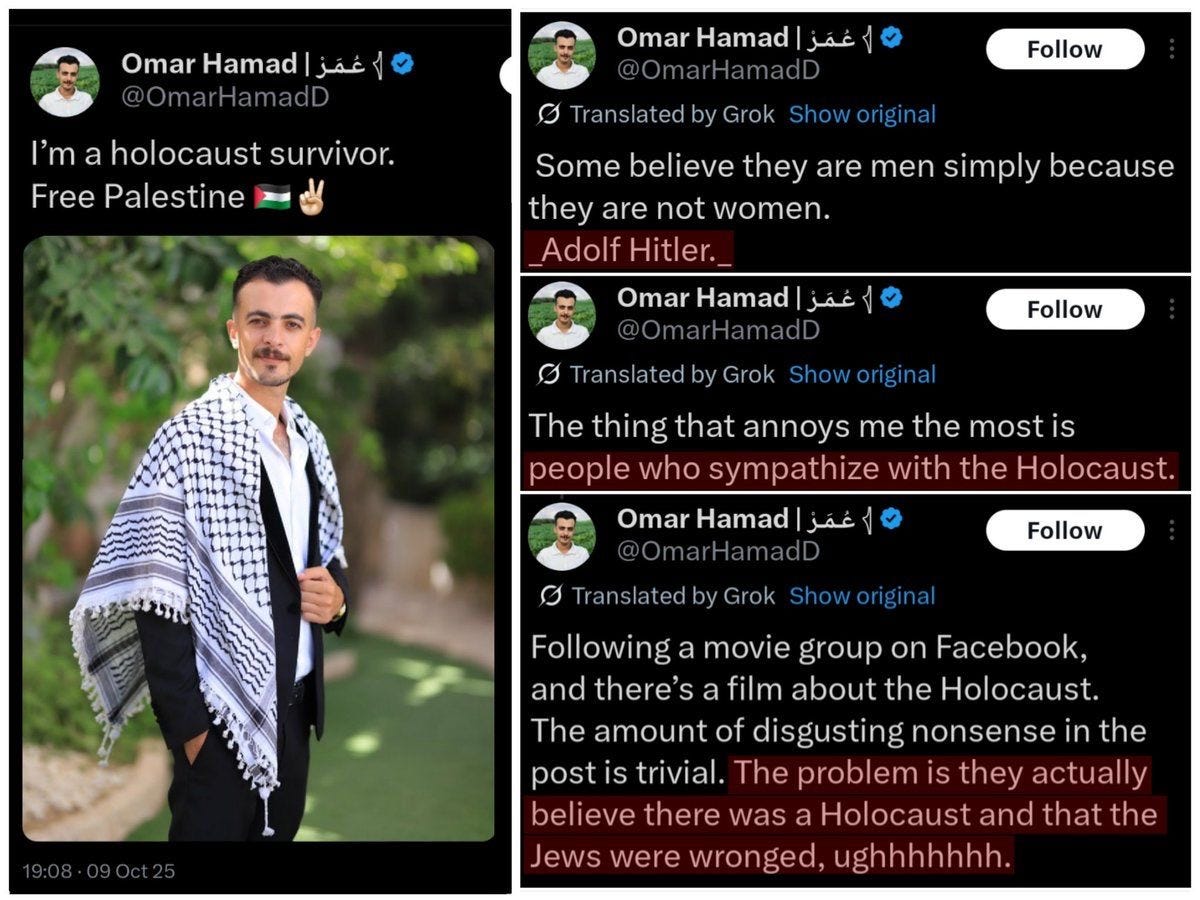

Perhaps one reason why this inferiority and victimhood complex exists is because the Arab world, and certainly the Palestinians, resent the idea that the Jews endured worse than they did. In the Arab world, Holocaust denial is rampant— a remnant of Nazi ideology that much of the Arab world enthusiastically participated in during WWII, coupled with religious contempt for Jews that originated in the 7th century. Whatever the reason, the Holocaust is simultaneously denied, appropriated, and celebrated in the Arab world today.
This so called “Holocaust Envy” is an interesting phenomenon to look at, because it gives status to genocide, and therefore can only exist by denying an actual genocide like the Holocaust— or else Jews, having actually endured the Holocaust, would be higher in “status.” The greatest irony in this is that the Holocaust was so immense and devastating, unlike ever seen before, that it became the reference point for how other atrocities are measured, which the movement now tries to claim.
The same scrambled, inverted logic can apply to the way the Palestine movement speaks of October 7th. The attacks, to many, never happened; but if they did, then they were justified. If crimes against civilians occurred, they were deserved because the victims were Israeli; and if Israelis died, then the IDF or Israeli government killed their own people. Israeli hostages taken on October 7th are prisoners; arrested Palestinians terrorists who participated in October 7th are hostages.
In early 2024, when South Africa brought its case against Israel at the International Court of Justice, the Palestine movement was furious when the court did not explicitly rule that genocide was occurring in Gaza and therefore order a ceasefire. Instead, the court issued provisional measures ordering Israel to prevent any acts described under the Genocide Convention, punish incitement, and enable humanitarian aid. Online, the dominant mood was anger that the verdict had not been worse, or at least enough to justify ordering Israel to halt their military campaign. Somehow, the reaction was one of outrage, not relief.
A similar pattern appeared with the so-called “famine” narrative. The World Health Organization reported that seventy-four Gazans had died of malnutrition— an appalling figure, but one that does not come close to the definition of famine, which would require mortality rates of more than a hundred times higher. Even by the most expansive counts cited by Hamas officials— around two hundred deaths related to malnutrition— Gaza has never met the statistical or epidemiological threshold for famine. Yet somehow, the response is not relief that mass starvation had been averted; when these reports surfaced, the response was denial or distortion.
When institutions stopped short of the maximal claim, time and time again, the dominant response— at least within social media and Arabic news outlets— was anger and disappointment rather than relief that the worst had not been found.
Consciously or subconsciously searching for catastrophic verdicts because they secure one’s identity is a form of self-hatred. Envying the Holocaust is too! It comes as no surprise that a movement that defines itself through catastrophe cannot actually achieve victory. The Palestinian identity depends on a perpetual narrative of victimhood, one that cannot exist without the Jews, whose Holocaust it frequently appropriates from to try to claim moral status while simultaneously denying Jewish suffering.
It is hard to imagine an end to such a movement such as theirs, sustained by complex hatred and distortion, other than self-destruction.