

The year was 1964. My grandparents had invited all their Iraqi friends to their house a little before 11:00 pm— Iranian time, an hour and a half ahead of Cairo, where something momentous was about to happen. Huddled around their small radio, they awaited the performance of a lifetime, which they planned to record over their turntable.
The moment music would start to flow out into the living room, they would drop the needle in order to etch an angelic voice onto a black vinyl disc in order to listen again and again, long after the performance had faded into static.
Who’s voice? The mother of voice, the star of the East: Umm Kulthum.
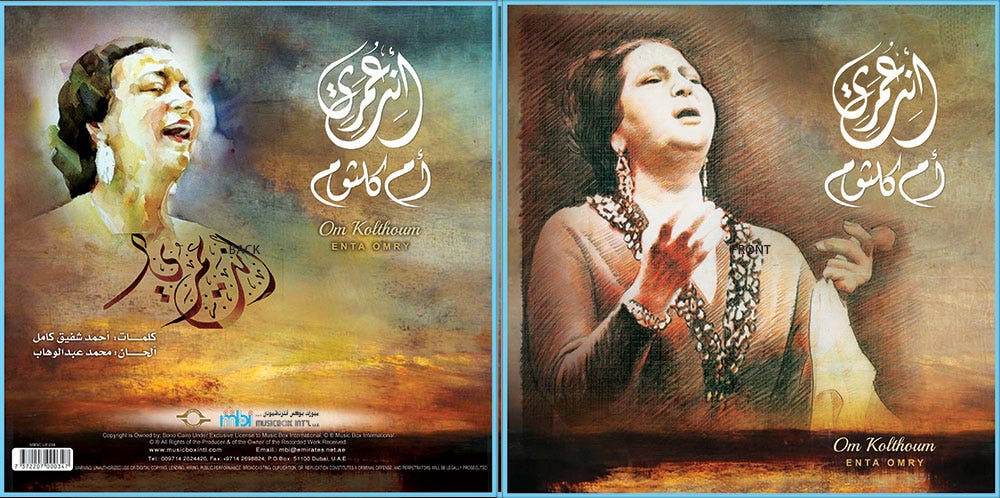
She was, unequivocally, the undisputed master that dominated traditional Arabic music with her classical, maqam-based style and powerful live performances. Like all divas, Umm Kulthum had fierce rivals. Mohamed “the modernizer” Abdel Wahab was perhaps her greatest adversary, the innovator and composer who embraced Western instruments, orchestration, and shorter song forms, whose style was more fluid, cinematic, and infused with European influences. For years, both the public and the press understood them as diametrically opposed in artistic philosophy, heated competitors in popularity and ego.
Yet, taking place live in Cairo that night would be liqa al-sahab— the meeting of the clouds— a near-mythic convergence of the two musical giants. More specifically, Umm Kulthum would be singing a song composed by Abdel Wahab, a legendary song called Enta Omry.
The music began, and Umm Kulthum’s quivering voice filled the room.
The needle dropped, the recording began.
My grandmother Simha was, evidently, a purist. When she heard Abdel Wahab’s modern, “European” arrangements mingling with the traditional Umm Kulthum’s voice, she was outraged. “That bastard!” she yelled, “That donkey! He’s trying to destroy her, he’s trying to make her a whore!” Comments like this from my grandmother carried on throughout the song’s entire forty-minute length. But by the end, even she could not resist Enta Omry’s allure. Abdel Wahab’s lush orchestration, romantic lyrics, and modern structure combined with Umm Kulthum’s classical vocal improvisation and emotional gravitas grounded in Arab tradition was a gorgeous, nostalgic fusion of old and new, East and West, traditional and modern.
For her most devoted fans, it was a jarring departure from “authentic” Arab music, but no one could deny its entrancing quality. The song became an instant classic.
Unfortunately, for my grandmother and her friends, the recording they took of the live radio performance was sprinkled with my grandmother’s outrage and curses, an iconic version in its own right.
When I close my eyes and recall its details, I find myself in the living room with my grandparents and their friends, in a different time and place; I hear their voices in a language I do not understand. I even hear Umm Kulthum for the very first time, singing her most iconic hit.
But my grandfather, Naamat, died before I was born. My grandmother Simha passed when I was three years old. All of this happened over sixty years ago. So how do I remember this story?
Ancient Jewish wisdom offers some insight but is still cryptic. Deuteronomy 32:7 tells us, “Remember the days of old; consider the years of generations past. Ask your father, and he will tell you; your elders, and they will explain to you.” The Torah commands remembrance of the generations past, but quite literally as a recollection, as if I directly experienced it. How is this possible? Because memory is part of inheritance, just as much as property or assets. The way I remember it is no doubt different from how it actually happened. Yet it becomes mine. Not because I lived it, but because it lives in me now.
There are barely any archives or records that exist in my father’s family beyond his generation. Instead, we use a kind of bodily, emotional time travel to verify events, dates, and places. No one, including my grandfather himself, knew his birthday; only that he was born the year the British came to Baghdad. I recall doing the historical mathematics in my head as a child, stitching family memory to historical and political events and eras: “My grandparents fled Iraq to Iran when the government turned on Jews; my father was born ten years later.” “My father and his family came to Israel at the start of the recession; they went back to Iran right before the 67’ war.” My father narrowly fled Iran at the height of the Islamic Revolution, after receiving a draft notice for the Iran-Iraq war. He was lucky. Hundreds of thousands of young, conscripted Iranian soldiers slaughtered in the war were not.
Flight, it seems, is in my family inheritance, at the very least in our contemporary inheritance. My great-grandparents, on the other hand, were part of a native Jewish community in Iraq for nearly a millennium, possibly longer. I can only assume that the small village my grandmother was born in, Nasiriyah, was the same one my great-grandfather was born in, and his father, and so on. Nasiriyah lies on the lower Euphrates river, southeast of Baghdad and close to the ruins of the ancient city of Ur. I imagine my grandmother often played on the riverbanks when she was a girl, washed laundry with her mother, or and had picnics there. My grandmother spoke about Nasiriyah like it was heaven on earth, a truly lovely place that buzzed with warmth and lighthearted village gossip.
Because of these stories, my father always wanted to visit. During my grandfather Naamat’s shiva in 1997, some friends of my grandparents brought along an Iraqi Jewish man that had just finished a visit in Iraq. When my father and his siblings heard that he had visited Nasiriyah, they were beside themselves with excitement. “Tell us about your time in Nasiriyah,” they asked, “What was it like?!”
“Hayee chola,” he said, “It’s a hole!” (A hole, meaning— it’s a mess.)
Through fits of laughter, my father relayed to my grandmother what the man had said to him. “Hatha himar,” she said, “ma gayyir esh ga’id yuhki.” (“This guy is a donkey, he doesn’t even know what he’s talking about.”)
But the man was right. The idyllic Nasiriyah of my grandmother’s childhood was much different than the Nasiriyah of the late 1990’s. By then, the Iran-Iraq war had turned much of southern Iraq into a militarized zone; it housed military installations and supply routes, marking it as a frequent target of Iranian shelling and airstrikes.
Then, in 1991, Nasiriyah again became a target during the Gulf War— in retaliation for Iraq’s invasion of Kuwait, U.S.-led forces bombed strategic sites around the country, including Nasiriyah. Following Iraq’s defeat, Shi’a uprisings erupted across the south in hopes of toppling Saddam Hussein. Ba’athist units crushed the rebellion in a matter of days, executing between 50,000 to 100,000 people, who were then buried in mass graves.
Iraq’s economy subsequently collapsed under international sanctions and trade restrictions imposed after the Gulf War, and Nasiriyah, already battered by war, sank deeper into poverty. In other words: it had been gutted. It was hollow. My grandmother’s beloved childhood home had become a hole. Given that it was also one of the most heavily bombed cities during the Iraq War of 2003, I can safely assume that any small trace of my family’s existence there is probably gone, if it wasn’t wiped out before.
Of course, my vivid imagination of what my grandmother’s childhood in Nasiriyah was like isn’t to say that her life in Iraq was perfect, and I would be remiss to romanticize it in any way.
Yes, life was simpler in those days; children also frequently died of diarrhea or malaria before they even learned to speak. Of the five children my great-grandmother had, only four survived into adulthood. In those days, especially in the more rural areas of Iraq, women were married off as soon as they received their menses, which could be as young as twelve years old. Often, they were married to men double or triple their age, and told nothing about what would happen in the bedroom after the ceremony. Only the day or week before, they had been playing with dolls.
My grandmother married my grandfather at fourteen years old. She had gotten her period two years earlier, but her mother hid it from her father in an attempt to delay for as long as possible what would normally be an imminent marriage. As the story goes, her father, my great-grandfather, had originally arranged a marriage for her with a forty year old, bald fiddler (bald, my amma always says as she recounts the story, not even a memory of hair). No dowry would be given— her father had negotiated— to which the fiddler graciously accepted, as my grandmother’s beauty was more than enough for him.
This legendary beauty was no exaggeration: unlike most Iraqi girls, she had fair skin, blonde hair, and blue eyes. Word of her betrothal swept through the Jewish community in Southern and Central Iraq like a tidal wave. Her betrothal ceremony, they decided, would be at her aunt’s house in Basra. Many visitors would travel a long way within the week leading up to the ceremony to give their congratulations— but more importantly, to get a good look at the bride-to-be before she was married.
At the time, my would-be-grandfather, Naamat, was living in Baghdad. He was in love with a divorced woman who he could never marry due to the cultural taboos of the era. A friend at work, unable to attend my grandmother’s betrothal ceremony, begged my grandfather to go in his place and report back to him. This friend was hoping my grandmother might still be “unclaimed” by the time he arrived— and if she was, then he planned to claim her himself, traditionally done by giving her a piece of gold jewelry.
This was no simple favor. By train, Baghdad to Basra could take more than eight hours, and by car, seven. Yet as fate would have it, my grandfather begrudgingly traveled to Basra, and to his surprise, immediately fell in love with my grandmother the moment he set eyes on her.
Back then, a man couldn’t propose on his own, even at 28 years old. He raced back to Baghdad, dragged his mother out of the house in her slippers and robe, and made the long trip back to Basra so she could perform the betrothal in his place. When they arrived, his mother discreetly gave my grandmother a beautiful gold bracelet. As the story goes, when people eventually realized what had happened, chaos broke out. It was quite the scandal— betrothed before the original man had even arrived! My grandmother’s mother said he must marry her immediately.
My grandfather agreed, and the women ran to the home of the city’s rabbi and dragged him out, insisting that the matter was urgent.
After completing the ceremony, the irritated rabbi complained that because of their demands, he was going to be late to officiate an engagement ceremony for a fiddler. You can imagine the rest: everyone shrieked and laughed, “That fiddler is not getting married today!”
There are a lot of legends in my family, but this one, I’ve been told, actually happened.
Luckily for my grandmother, my grandfather was kind, gentle, and for his era, quite progressive. Though twice her age, he refused to consummate their marriage or have her move hundreds of miles away to Baghdad to live with him and his mother until she got to know him better, and felt comfortable around him. For the next several months, he visited her in her family home in Nasiriyah and spent time with her.
After she eventually moved into his family home, his mother promptly placed them in separate bedrooms, insisting that my grandmother was still much too young. Despite her efforts to keep them apart, my grandmother— quite obedient and submissive before marriage— had bloomed into her fiery, strong-willed self. Needless to say, her secret visits to my grandfather’s room at night were eventually discovered when she became pregnant. Many marriages in that time and place were quite sad, given they were typically defined by child marriage and the near-total erasure of a young woman’s agency. Which is why I am happy to report that my grandparent’s marriage was one of deep love and mutual admiration, despite its challenges.
Those challenges were often ones they had no control over. In 1941, four years before their marriage, a pro-Nazi coup led by Rashid Ali al-Gaylani briefly ousted the pro-British Hashemite monarchy of King Faisal the Second and his regent uncle, Abd al-Ilah. Britain subsequently invaded once more and reasserted their control, installing a new government, but nefarious forces were simmering under the surface. Antisemitic sentiment was growing, especially after the Farhud pogrom of 1941 that shook Baghdad’s Jewish community to the core.
My grandfather never spoke about this period. One can only imagine why.
Life after the Farhud was never the same. Still, despite how Iraqi Jewry’s sense of safety was permanently shaken by what had transpired, things slowly returned to normalcy. With hindsight, it’s easy to say the red flags were there, that the pot was continuing to simmer, that the golden era for Iraq’s Jews was on the verge of collapse. But for Jews living in Iraq in 1945, that wasn’t necessarily obvious to them. No one could have predicted that within just a few years, everything they knew would fall apart. By 1945, Iraq’s Jewish community was one of the largest and most vibrant in the Middle East; Jews made up one-third of Baghdad’s population and were deeply integrated into the commercial, cultural, and professional life of the city. They were doctors, merchants, teachers, government clerks, musicians and writers. Baghdad’s Jews were often highly literate, multilingual, and overrepresented in higher education relative to their population size. Yes, there had been ruptures— the Farhud, the al-Gaylani coup— but for many, it seemed like the worst had passed, certainly compared to what European Jews were facing in 1945. Things had stabilized. The community had regained their footing. Daily life resumed, schools reopened, businesses thrived, and people carried on.
They couldn’t have imagined what was coming next.
For many years, I associated the mass exodus of Iraqi Jews with the rise of the Ba’ath party in the 1960s. But the truth is that most Jews— including my grandparents— had fled nearly a decade earlier, under the Hashemite monarchy. This was the same pro-British regime that had governed Iraq since the 1920s and had, for a time, overseen a period in which Jews were deeply integrated into Iraqi society. But after Arab armies— including Iraq’s— failed to destroy the newly declared State of Israel in 1948, everything suddenly began to change. Iraq had initially joined the war as part of the Arab League, under intense pressure to support the Palestinians and prove its appeal to the growing Arab nationalism in their population.
The Hashemite regime, already widely unpopular due to their pro-British stance, couldn’t afford to look weak or, worse— sympathetic to Jews.
It turned on its Jewish citizens relatively quickly in order to appease the public. By the end of 1948, mass dismissals from government jobs, intense surveillance of Jewish schools and synagogues, and arrests on vague accusations of Zionist activity were commonplace within Iraqi society. By 1949, they banned Jewish emigration out of Iraq altogether, trapping them in a now a nearly boiling pot. Only in 1950 did it suddenly reverse course: they offered Jews the chance to leave Iraq once again, but only if they renounced their citizenship and relinquished everything they owned. My grandparents must have hesitated, like many did. To leave Iraq would be to leave everything and everyone they had known. After what I can only imagine was intense deliberation, they decided to leave with what they could carry. As soon as they were registered to leave, the rest would be ceased by the state.
I’ve heard many stories of Iraqi Jews selling their homes or businesses to their non-Jewish neighbors for next to nothing, just to salvage a little cash before leaving. These were under-the-table sales, often for a sliver of the property’s real value. Buyers knew that Jews desperately racing to sell their property before fleeing had no real bargaining power.
They were extorted, squeezed like a sponge; some buyers never paid at all, knowing the owners would soon be gone and had no legal recourse. I recall sitting in a Middle Eastern restaurant in Los Angeles as a teenager and striking up a conversation with the restaurant owner: a kindly man in his fifties, who, to both our delight, was also Iraqi. “My father helped the Jews when they left Iraq,” he proudly said, “He bought property from them when they were about to lose it all.” Being a young and naive girl, I was awe-struck upon hearing this— here was a man who had a direct connection to my family’s community back in Iraq, and at that, a positive one!
It was only later on, when I excitedly recounted the story to my father and a flash of anger and disgust crossed his face, that I understood that this wasn’t a heartwarming story at all. “Oh, really?” he sharply said, “His father helped the Jews? By buying their homes for ten dollars?” He shook his head. “You don’t know what they did to us.”
I wouldn’t know for a long time. I wouldn’t know because no one actually explained to me everything that had happened. Just like how my grandfather never spoke to anyone about the horrors of the Farhud— being 24 and living in Baghdad at the time when it happened— my father and his siblings never spoke about what happened in Iraq.
They never spoke about it, but not just because they preferred to not speak about depressing events. It also was simply not their experience. They were all born and raised in Iran. My grandparents left Iraq when they were relatively young, my grandmother being 18 and my grandfather being 32. If you were a Jew hoping to leave Iraq in 1950, the only way out was by crossing the eastern border into Iran. From there, Jews who had fled Iraq could continue onto Israel by plane, since Iran— at least under the Shah’s rule— maintained quite friendly relations with Israel at the time.
But many, like my grandparents, arrived in Iran and stayed. The cosmopolitan city of Tehran, in many ways, was much more sophisticated than the early Zionist state, which was still highly undeveloped and under major security threats. A small community of Iraqi Jews began to take shape in the city. In general, the Shah’s government embraced its Jewish population. Still, the transition could not have been easy. Despite sharing an alphabet, Arabic and Farsi are completely different languages, and my grandparents didn’t speak a word of the latter when they first arrived. They had to learn.
I don’t know if my grandparents were among the founding residents of the Iraqi Jewish enclave in Tehran, but they were certainly part of its first wave. There was, of course, already a well-established Persian Jewish community in Iran which had been there for centuries, if not millennia. But my grandparents were adamantly not a part of this community. They were Iraqis, they insisted, not Persians.
Soon, there were Iraqi Jewish clubs, synagogues, and shops that made up the Iraqi Jewish community of Iran. The language spoken was Judeo-Arabic. The customs were Baghdadi, although the food was a mix of Persian and Iraqi— because who can resist Persian food? Certainly not my family. It is this experience— the one of Iran— that my father so fondly remembers growing up with. Of course, his own frantic departure from Iran, decades later, would look very different than his parents’ from Iraq.
As my grandparents fled to Iran, the British said little as Iraqi Jews were choked out by the Hashemite regime which they had installed only a couple decades earlier. By then, they were much more focused on protecting oil relationships and stabilizing their regional influence than responding to the growing persecution of Jews that their client regime was driving. According to Sir Henry Mack, the British Ambassador in Baghdad, the Hashemite regime was “too weak to lead public opinion,” and any effort to improve the position of Jews would provoke nationalist backlash. The Foreign Office also blocked Jewish organizations in Britain from obtaining its reports on Iraq’s anti-Jewish policies from fear of British Jews protesting.
And so the Jews of Iraq, Babylonian Jews whose lineage stretched back thousands of years, were left to pack what they could carry and disappear. And I didn’t live through any of it, but now it lives in me.
Beautiful reminder of the deep Jewish connection to the Fertile Crescent, to modern day Iraq and Iran and the culture of the region.
Thank you for the insight - a world I knew nothing about. Listening to Umm Kulthum now…